Physical Address
304 North Cardinal St.
Dorchester Center, MA 02124
Physical Address
304 North Cardinal St.
Dorchester Center, MA 02124
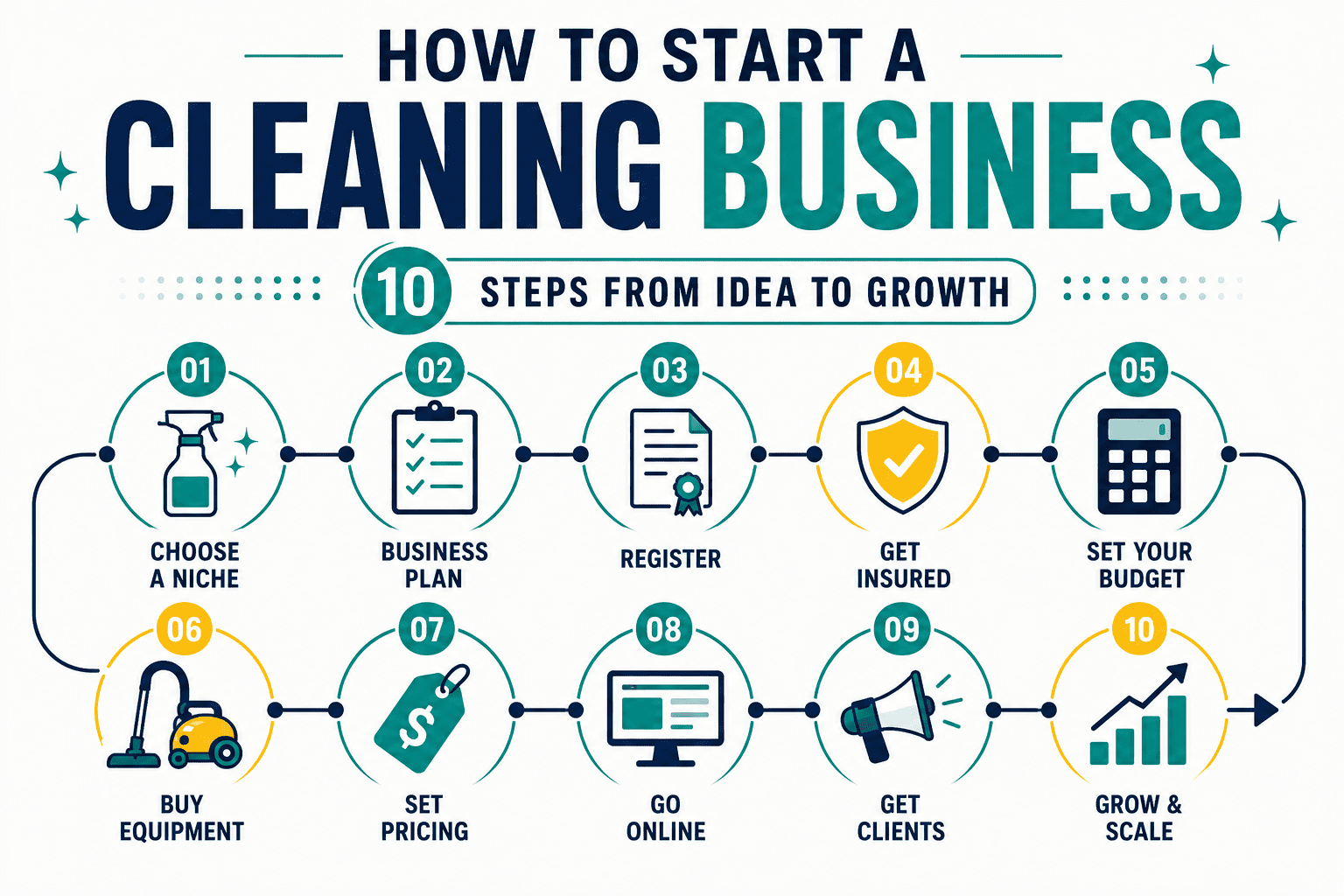
The cleaning services industry in the United States employs more than 3 million people and generates over $100 billion a year, and it doesn’t ask for a fraction of that revenue as an entry fee. A laptop for scheduling, a car, and a few hundred dollars in supplies is enough to start taking on clients. That low barrier to entry is exactly why the industry attracts so many first-time business owners, and exactly why so many of them plateau within the first year: it’s easy to start cleaning, and much harder to build a business around it.
The difference between the two usually comes down to whether you treat the early decisions, your niche, your pricing, your legal setup, as an afterthought or as the foundation. This guide walks through both, in order.
“Cleaning business” covers a wider range of work than it sounds like, and picking a lane early shapes almost every decision that follows, from the equipment you buy to the clients you market to.
The broad categories worth considering:
Residential is the most common starting point because it requires the least capital and the fastest path to your first paid job. Many owners start there and add commercial or specialized services once they have consistent revenue.
You don’t need a 40-page document to start a cleaning business, but skipping this step entirely tends to catch up with owners around month six, usually as a pricing problem or a cash flow problem that a plan would have caught earlier.
At minimum, put in writing:
This is also the point to decide whether you’re building a side income or a company you intend to hire into. That decision affects your legal structure, your insurance needs, and your pricing, so it’s worth answering honestly now rather than backing into it later.
Most new cleaning businesses choose between two structures:
Sole proprietorship: The simplest option. No separate legal entity, no formation paperwork, and your business income passes through to your personal tax return. The tradeoff is personal liability: if the business is sued or can’t pay a debt, your personal assets aren’t protected.
Limited liability company (LLC): A registered business entity that separates your personal assets from business liabilities. Costs more to set up (typically a few hundred dollars in state filing fees) and requires some ongoing paperwork, but it’s the more common choice once you start hiring or taking on commercial clients, since it limits your personal exposure if something goes wrong on a job.
Once you’ve picked a structure, registering typically involves:
Most U.S. states don’t require a specialized cleaning license, but nearly every serious client, and every commercial contract, will expect proof of insurance before letting you in the door.
General liability insurance covers property damage and client injuries that happen on the job, a client’s flooring gets damaged, someone slips on a wet floor, and it typically runs $500 to $1,500 a year for a small operation. Most residential and virtually all commercial clients will decline to hire an uninsured cleaner, so treat this as a startup cost rather than an optional add-on.
A surety bond (often called a janitorial bond in this industry) [a policy that reimburses a client if an employee steals from them or causes intentional damage] costs somewhere between $100 and $500 a year and does double duty: it protects your clients, and it signals credibility to prospects who’ve never worked with you before.
Workers’ compensation insurance becomes a legal requirement in most states the moment you hire your first employee, with costs varying by state and payroll size.
Commercial auto insurance is worth adding once you’re driving to job sites regularly, since a personal auto policy typically won’t cover accidents that happen while conducting business.
Two more compliance areas are easy to overlook because they don’t come with a fee or a form, but they carry real liability. If your team handles cleaning chemicals, OSHA (the Occupational Safety and Health Administration) [the federal agency that sets workplace safety standards] expects proper labeling, safe storage, and basic safety training, even for a two-person operation. And if your marketing makes specific claims, “100% eco-friendly,” “satisfaction guaranteed”, those claims need to hold up. Truth-in-advertising rules apply to a solo cleaner exactly the same way they apply to a national chain.
Budget roughly $1,000 to $3,000 a year for a solo operator’s full insurance and bonding package, more once you add employees and vehicles.
Total startup costs for a cleaning business vary enormously depending on your niche and whether you’re hiring from day one:
| Cost Category | Solo / Home-Based | Small Team / Commercial |
|---|---|---|
| Business registration & licenses | $50–$400 | $200–$800 |
| Insurance & bonding (first year) | $1,000–$2,300 | $3,000–$6,000 |
| Equipment & supplies | $500–$1,500 | $2,000–$10,000+ |
| Marketing & branding | $200–$1,000 | $1,000–$5,000 |
| Software (scheduling/CRM) | $0–$50/month | $100–$300/month |
| Typical total to launch | $2,000–$5,000 | $10,000–$50,000+ |
A useful way to sanity-check your own number: total startup cost is roughly your one-time setup costs, plus your first month of recurring expenses, plus a cushion of one to three months of expenses in case client acquisition takes longer than expected. Commercial and franchise operations sit at the high end of this range; a solo, home-based residential operation can realistically launch closer to the low end.
What you need depends on the niche from Step 1, but a solo residential operation typically starts with the following, organized by category:
Cleaning products: An all-purpose cleaner, a streak-free glass cleaner, a degreaser for kitchens, a bathroom cleaner for soap scum and hard water stains, a wood- or tile-safe floor cleaner, and furniture polish. Stock eco-friendly versions of each if that’s part of your positioning.
Tools: Microfiber cloths in multiple colors (color-coding by room prevents cross-contamination), a mix of sponges and scrubbers for different surfaces, a spray mop for small jobs and a bucket mop for larger ones, a commercial-grade vacuum (HEPA-filtered if you’ll be working in allergy-sensitive homes), and an extendable duster for ceiling fans and high shelves.
Storage and transport: A cleaning caddy for moving supplies room to room, a rolling cart for bigger jobs, and a way to keep your vehicle organized so supplies don’t leak or shift in transit.
Safety gear: Disposable nitrile gloves, masks or respirators for dusty or heavily chemical jobs, an apron or uniform, heavy-duty trash bags, and a basic first aid kit.
Admin and marketing tools: Business cards, scheduling and invoicing software (more on this in Step 10), and branded shirts or aprons, which do quiet work toward looking established on day one.
Specialized niches add their own equipment on top of this baseline: carpet cleaning requires an extractor, post-construction work often calls for industrial-grade vacuums and heavier protective gear, and commercial contracts may require floor buffers or pressure washers. Buying equipment costs more upfront; leasing lowers the initial outlay but adds a recurring monthly cost, worth weighing against how confident you are in steady, near-term revenue.
Pricing is where a lot of new cleaning businesses either underprice out of nervousness or guess too high and lose bids, and both mistakes are avoidable if you start from your own numbers rather than a competitor’s website.
Before picking a model, calculate your baseline cost per hour of cleaning: your own labor (or your team’s wages, plus taxes and any benefits), the supplies used per job, transportation (gas and vehicle wear), and a share of your fixed overhead, insurance, licensing, software, marketing. Add your target profit margin on top of that number, and you have a floor you shouldn’t price below, whatever model you choose.
From there, four pricing models cover most of the industry:
| Pricing Model | How It Works | Best For |
|---|---|---|
| Hourly rate | Charge for time worked, typically $25–$50/hour per cleaner | New businesses still learning how long jobs actually take |
| Flat rate | A fixed price per job regardless of time spent | Established businesses with a clear sense of job duration and value-based positioning |
| Room rate | A set price per room | Simple, predictable jobs with consistent room sizes |
| Square footage rate | Priced per square foot of the space | Larger commercial jobs where footage is the clearest cost driver |
Hourly pricing is the safer starting point precisely because you don’t yet know your average job duration. Once you’ve completed enough jobs to estimate time accurately, flat-rate pricing tends to be more profitable, since efficient work no longer costs you money the way it does under an hourly model. Whichever model you use, check what comparable cleaners in your area actually charge, and be transparent in your quotes about what’s included, laundry, dishwashing, and inside-appliance cleaning are common gray areas, so a client isn’t surprised by an add-on fee mid-job.
Before you actively market anything, get the basics in place. Over 80% of people research a cleaning service online before hiring one, and a missing or thin online presence is one of the fastest ways to lose a job to a competitor who simply looks more established.
At minimum:
Once the foundation is in place, the highest-return marketing tactics for a new cleaning business tend to be the ones that cost the least:
For commercial and specialized niches, direct outreach tends to outperform digital marketing: contacting property managers, real estate agents, and local businesses directly, and joining your local chamber of commerce to build the relationships that lead to referrals and contracts.
Whichever channels you use, track where each client actually came from. It’s the only way to know which dollar of marketing spend is doing the work.
Even a solo operation benefits from scheduling and invoicing software rather than a paper calendar, both for your own organization and because clients expect the convenience of online booking. Tools built specifically for the industry (options like Jobber, Housecall Pro, and ZenMaid come up often) typically bundle scheduling, invoicing, and client communication in one place.
As the business grows, the same questions come up for most owners: when to hire your first employee, whether to expand into a second niche or a wider service area, and how to keep quality consistent once you’re no longer the one holding the vacuum. None of that needs to be solved on day one, but it’s worth revisiting once you have a handful of steady clients and a clearer sense of what’s actually working.
Starting a cleaning business doesn’t require much capital, but it does require getting the unglamorous parts right early: the right legal structure, real insurance, a pricing model you can actually defend, and a plan for finding clients that doesn’t rely on luck. Get those in place, and the industry’s biggest advantage, low overhead and genuinely recurring revenue, starts working in your favor instead of exposing you to risk you didn’t plan for.