Physical Address
304 North Cardinal St.
Dorchester Center, MA 02124
Physical Address
304 North Cardinal St.
Dorchester Center, MA 02124
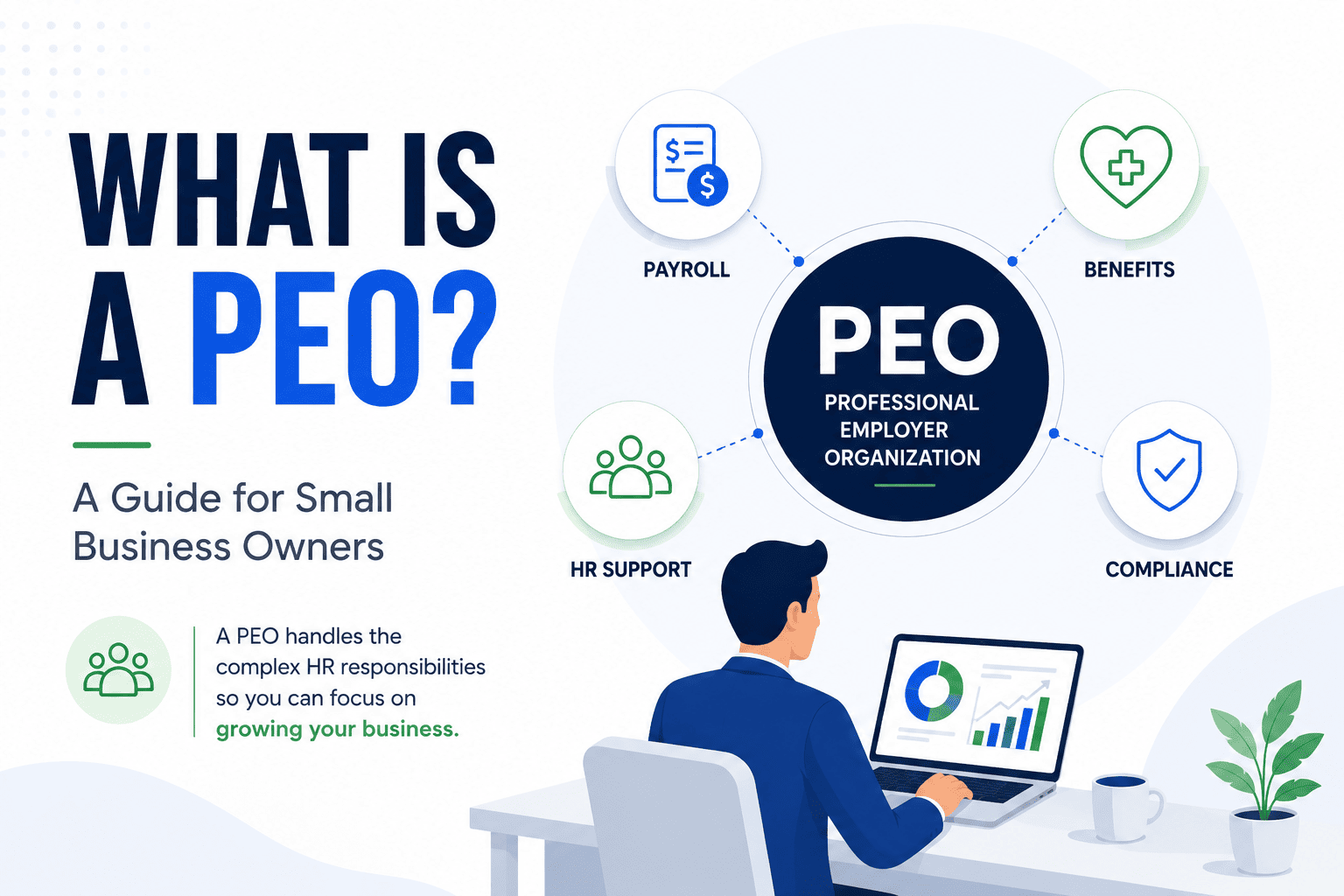
Running payroll. Filing employment taxes correctly in every state you operate in. Negotiating health insurance rates that don’t make your best candidates laugh and walk away. For a business with 200 employees and a full HR department, none of this is remarkable. For a business with 20 employees and one overworked office manager, it can consume an entire week every month. That gap is exactly what a professional employer organization, or PEO, exists to close.
A PEO is a third-party company that partners with your business to share specific employer responsibilities, handling payroll, tax filing, benefits administration, and compliance, while you retain full control over hiring, daily supervision, and how the work gets done. This shared-responsibility structure is called co-employment [a legal arrangement in which two organizations divide employer duties for the same group of workers]. It sounds simple enough on paper, but business owners tend to have the same handful of questions before they’ll trust a third party with something this sensitive. This guide answers them.
Under a co-employment agreement, employer responsibilities get split between two parties rather than resting entirely with one.
The PEO typically takes on:
Your business keeps:
Nothing about this arrangement makes the PEO your boss, and nothing about it makes your employees “belong” to someone else in any meaningful sense. Employees still show up, report to their managers, and do their jobs exactly as before. The change happens almost entirely behind the scenes, in who is filing the tax forms and negotiating the insurance rates.
No, and this is probably the most common mix-up. A staffing agency finds and places workers, often on a temporary or contract basis, and the agency is generally the sole employer of record [the entity legally and financially responsible for an employee’s tax filings and payroll] for those placements.
A PEO doesn’t recruit anyone. It works with the employees you already have, or hire directly yourself, and shares employer obligations for them rather than owning the relationship outright. If your goal is to find workers, you want a staffing agency. If your goal is to offload the administrative weight of employing the workers you already have, a PEO is the closer fit.
Three acronyms tend to get thrown around interchangeably in this space, and they shouldn’t be.
| PEO | ASO | EOR | |
|---|---|---|---|
| Employment structure | Co-employment — responsibilities shared | No co-employment — you stay sole employer | Sole legal employer — full responsibility shifts to the EOR |
| Who files payroll taxes | Typically reported under the PEO | Your business, under its own tax ID | The EOR, under its own entity |
| Who holds compliance liability | Shared, though a CPEO absorbs federal tax liability | Your business, entirely | The EOR, entirely |
| Best suited for | Businesses wanting benefits access plus shared HR liability | Businesses with some internal HR wanting admin support only | Hiring in a state or country where you have no legal entity |
| Geographic reach | Mostly domestic | Domestic | Domestic or international |
The short version: co-employment and shared liability point you toward a PEO; full outsourced administration with you retaining sole liability points to an ASO; hiring across a border you don’t have a legal entity in points to an EOR.
Not every PEO relationship looks the same. Most providers offer some version of two core models.
Full-service (or “classic”) PEO. You hand over the complete package: payroll, benefits, compliance, workers’ compensation, and HR support, all bundled together. This is the more common setup and tends to suit businesses that want to offload HR administration entirely rather than piece by piece.
Carve-out (or “à la carte”) PEO. You select specific services rather than the full bundle. For example, payroll and compliance support, while keeping your existing broker for benefits or your own workers’ comp policy. This model tends to suit businesses that already have some HR infrastructure in place and only need to fill specific gaps.
Which model makes sense often comes down to how much you already have set up internally, and how much you’re willing to standardize around a single provider’s systems.
PEOs generally price their services one of two ways: a flat per-employee-per-month (PEPM) fee, or a percentage of total payroll.
Flat fees tend to fall somewhere between roughly $40 and $160 per employee per month, depending on the provider, the services bundled in, your industry’s risk profile, and how many states you operate in. Percentage-based pricing tends to land between 2% and 12% of payroll. Industry-wide, the average cost works out to somewhere around $1,300 to $1,400 per employee per year.
Here’s the detail that catches people off guard: the pricing model that saves you money depends heavily on your average wage. Flat PEPM pricing tends to favor businesses with higher-paid employees, since the fee doesn’t scale up with salary. Percentage-of-payroll pricing tends to come out cheaper for businesses with lower average wages. Above a certain average salary, agreeing to percentage-of-payroll pricing can quietly cost you far more than a flat fee would.
Whatever the sticker price, ask specifically what it includes. Setup fees, workers’ compensation “true-up” charges, early termination penalties, and benefits markups are common places where the real annual cost ends up higher than the number in the sales pitch.
Is it worth it? Industry benchmarks suggest businesses using a PEO see average savings in the range of a 25%+ return relative to what they spend on fees, largely driven by access to group health insurance rates that a small standalone business could never negotiate on its own. Whether that math works for your specific business depends on your headcount, your current benefits spend, and how much time your team is currently sinking into administrative work.
Access to enterprise-level benefits. Because a PEO pools employees across many client businesses, it can negotiate health insurance, dental, vision, and retirement plan rates that would otherwise only be available to much larger companies. For a 15-person company trying to compete for talent against a 500-person company, this can be the single biggest draw.
Reduced administrative load. Payroll, tax filings, and compliance paperwork move off your plate and onto a team that handles it full-time, for many clients, every single day.
Compliance support across states. Employment law varies by state and changes constantly. A PEO’s compliance team tracks it so you don’t have to, which matters even more once you have employees working in more than one state.
Easier multi-state hiring. Hiring someone in a new state can require registering your business there, a process that can take weeks. Working through a PEO’s existing infrastructure can remove that bottleneck.
Lower workers’ compensation exposure. PEOs negotiate coverage across their full client pool, which can mean better rates and smoother claims handling than a small business would get on its own.
Some loss of control. Co-employment means sharing certain decisions, including which benefit plans are available, that you might otherwise make entirely on your own.
Cost that scales with headcount. As your team grows, so does the bill. At a large enough size, the math can flip, and an in-house HR hire or standalone insurance broker may end up cheaper.
You’re not fully off the hook. A PEO can make mistakes, and in most cases your business still carries some liability for compliance failures, even ones the PEO caused. Working with a PEO that holds IRS certification as a Certified Professional Employer Organization (CPEO) [a voluntary IRS status confirming the PEO meets financial and compliance standards] narrows this risk specifically for federal employment taxes, since a CPEO assumes sole liability there. It does not eliminate every category of liability, so read the contract closely.
Switching later can be disruptive. Moving away from a PEO, or from one PEO to another, often means payroll history and benefit enrollments effectively start over, which is worth factoring in before you sign a multi-year contract.
A PEO tends to make the most financial and practical sense for businesses that check most of these boxes:
Businesses well outside that range often find better value elsewhere. Very small teams may find a PEO’s fees outweigh the benefit, and payroll software alone gets the job done. Very large companies with in-house HR expertise and strong existing group rates may find a standalone insurance broker matches PEO-tier benefits without the shared employer structure or contract terms.
Not all PEOs are created equal, and the differences show up mostly in the fine print. Before signing anything, it’s worth working through a short list:
A PEO isn’t a universal fix for small business HR headaches, and it isn’t a scam dressed up in HR language either. It’s a trade: you give up some administrative control and pay an ongoing fee, in exchange for access to better benefits, lighter compliance risk, and hours back in your week. For a business straining under its own payroll and paperwork, that trade is often worth it. For a five-person company with a simple setup, it often isn’t yet.
The right call comes down to your headcount, how much time HR administration is currently costing you, and how much you value handing that weight to someone else. Running the numbers against your actual payroll, rather than a provider’s marketing page, is the only way to know for sure.
