Physical Address
304 North Cardinal St.
Dorchester Center, MA 02124
Physical Address
304 North Cardinal St.
Dorchester Center, MA 02124
I once spent a full Saturday re-filming a 40-second video about a spreadsheet trick, adjusting my ring light like I was prepping for a Netflix special. Final view count: twelve. Eleven were almost certainly my mother.
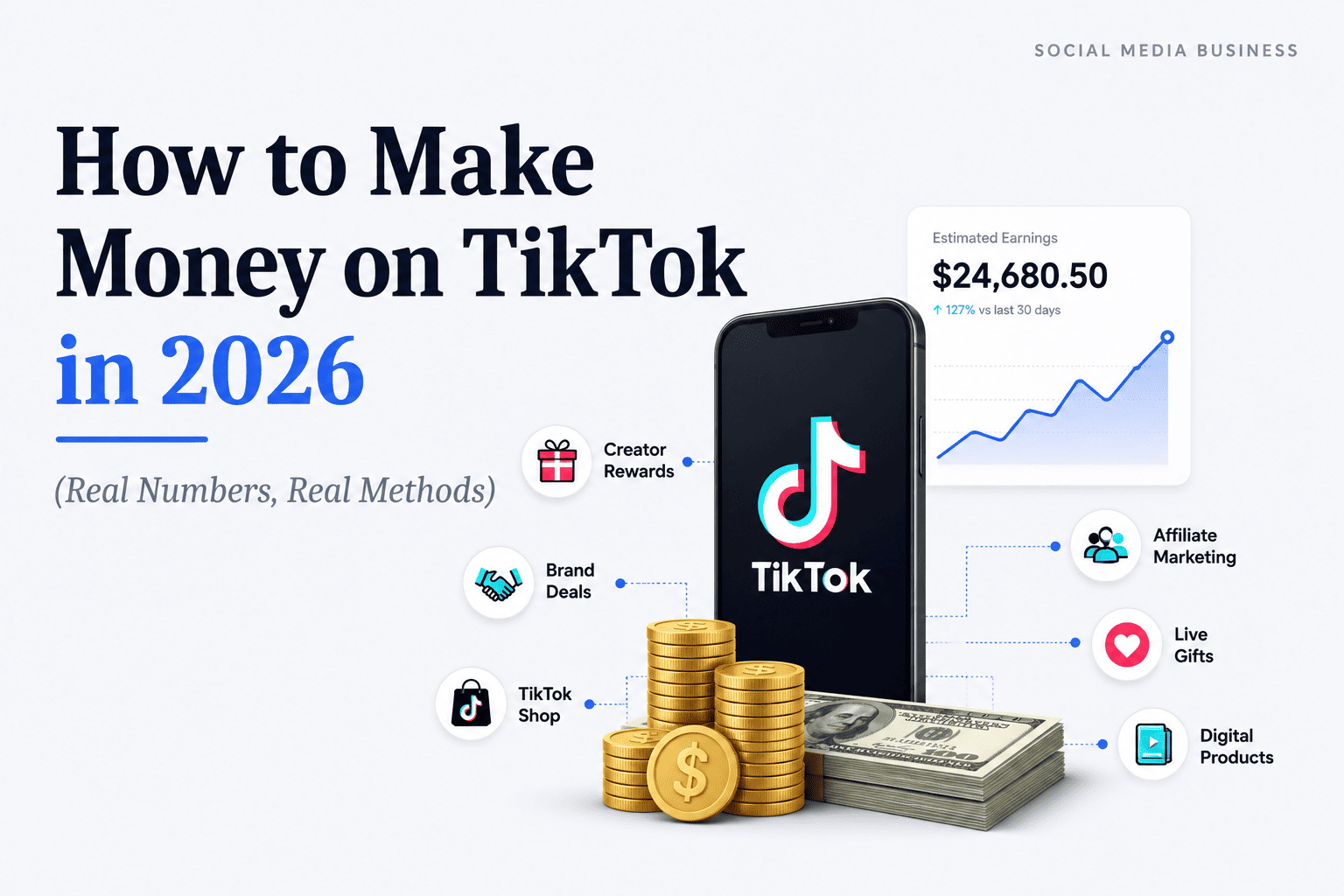
Does that mean TikTok’s a lost cause unless you’re already famous? Not even close. It means most of us chase virality when we should be chasing income streams and TikTok has more of those built in than people realize. Here’s exactly how creators and small businesses are earning money on the platform in 2026:
(Wondering whether it’s even worth building on TikTok given all the ownership drama, the app is fully stable and operating normally in the US; more on that below.) Now let’s get into what each of these actually looks like in practice.
Not as much as you’d think. TikTok’s algorithm has always leaned toward rewarding relevant, engaging content over sheer follower count, which is part of why the app is littered with accounts that went from zero to six figures in views seemingly overnight. That doesn’t mean followers are irrelevant (several monetization tools below have hard follower thresholds), but it does mean the starting point isn’t “get famous first.” It’s picking a niche specific enough that the algorithm knows exactly who to show you to, and posting consistently enough that it has enough data to do so.
The Creator Rewards Program is TikTok’s built-in system for paying creators directly for their videos’ performance – it replaced the older Creator Fund, which paid out notoriously little. To join, you’ll generally need at least 10,000 followers and 100,000 video views in the past 30 days, along with a few other account-standing requirements.
Once you’re in, don’t expect to quit your day job on day one. Most eligible creators are currently earning somewhere in the range of $0.02 to $0.04 per 1,000 views – meaning a video that pulls in a very respectable one million views might net you $20 to $40 directly from TikTok. It’s not nothing, but it’s rarely the main event. Payouts also aren’t fixed; they shift based on watch time, viewer location, and how well a video holds attention, which is TikTok’s polite way of saying it pays for engagement, not eyeballs.
How to actually apply:
Yes – and for a lot of small business owners, this is where TikTok stops being a vanity project and starts being a sales channel. TikTok Shop [the platform’s built-in storefront feature, which lets viewers buy products without ever leaving the app] works two main ways. You can sell your own inventory directly through shoppable videos and LIVEs, or you can become an affiliate, promoting other brands’ products and earning a commission every time someone buys through your link or video.
The affiliate route is particularly appealing if you don’t have your own product yet: you pick items in your niche, film honest reviews or tutorials, and get paid a percentage of whatever sells. It works best when the products genuinely fit what your audience already trusts you to talk about – an audience can smell a mismatched sponsorship from a mile away.
Setting up as a seller:
Setting up as an affiliate (no product required):
This is one of the more persistent myths about influencer income, and it’s simply not true anymore. Brands increasingly favor micro-influencers – creators with smaller but highly engaged, niche-specific audiences – precisely because the engagement rates tend to be higher and the sponsorship cost is lower. TikTok’s Creator Marketplace [the platform’s official tool for connecting brands with creators for paid partnerships] is the most direct route in, but plenty of deals still happen the old-fashioned way: a brand slides into your DMs after your video about their product category performs well.
If you’re a small business owner rather than a full-time creator, this cuts both ways – you can be the one paying for a sponsorship, or you can build your own following around your expertise and start receiving offers yourself.
Getting listed on Creator Marketplace:
For creators comfortable in front of a camera in real time, TikTok LIVE opens up a couple of additional income streams. Viewers can purchase virtual coins and send them as gifts during a livestream, which you can later cash out for real money. TikTok has also rolled out LIVE subscriptions, letting your most dedicated followers pay a recurring fee for extra access or perks.
Neither of these will replace a salary on their own, but for creators who already livestream – Q&As, tutorials, behind-the-scenes business content – it’s largely supplemental income for something you might be doing anyway.
How to start earning from LIVE:
If you have actual expertise, this is often the highest-margin option on the list. Digital products – templates, guides, mini-courses, presets – cost nothing to reproduce once they’re made, and TikTok is remarkably good at demonstrating expertise in short, snackable clips that funnel viewers toward a “link in bio” purchase.
Physical merch works too, and print-on-demand services have made it accessible even for creators with zero warehouse space: you design it, a third party prints and ships it per order, and you never touch inventory. It’s a lower-margin option than digital products, but it doubles as a brand-building exercise if your audience is genuinely loyal.
Launching a digital product:
Launching print-on-demand merch:
Because algorithms change, monetization terms change, and platforms can wobble overnight – TikTok proved that better than almost anyone over the past two years. For the record, that drama is currently resolved: as of January 2026, TikTok’s US operations run under a new joint venture, TikTok USDS, roughly 80% owned by American and allied investors including Oracle, Silver Lake, and MGX, with ByteDance [TikTok’s Chinese parent company] holding a minority stake under 20%. The Department of Justice confirmed just this month that the app no longer falls under the federal device ban that once applied to it.
Still, “resolved for now” isn’t “guaranteed forever.” The creators who treat their TikTok earnings as durable, long-term income are almost always the ones who used TikTok to build something they actually own: an email list, a website, a customer base that would survive even if the app disappeared tomorrow.
None of this means TikTok isn’t worth your time – clearly, it is, for a lot of people making very real money on it right now. It just means the goal was never to have a viral video. It’s to have a business that happens to include one.
As for my spreadsheet video? Still sitting at twelve views. But I’ve learned my lesson: next time, I’m at least going to try to sell something.
