Physical Address
304 North Cardinal St.
Dorchester Center, MA 02124
Physical Address
304 North Cardinal St.
Dorchester Center, MA 02124
I once spent three weekends building a meal-planning template in Notion- color-coded, beautifully organized, genuinely useful. I priced it at $19. I sold four copies. Two were to my mom, who I’m fairly sure just felt bad for me.
So no, digital products are not automatically passive income, and anyone telling you otherwise is usually selling something. What they are is one of the lowest-overhead ways to build a real side income, if you pick the right product for the effort you’re actually willing to put in. Below are 20 of them, ranked honestly by how much work they take versus what they tend to pay.
Digital products are intangible goods like ebooks, templates, online courses, presets, and other downloadable files, that are created once and sold repeatedly online with no inventory, shipping, or per-unit production cost. That “create once, sell many times” model is what makes the margins good, but it doesn’t make the creation effortless — that part still varies wildly by product type.
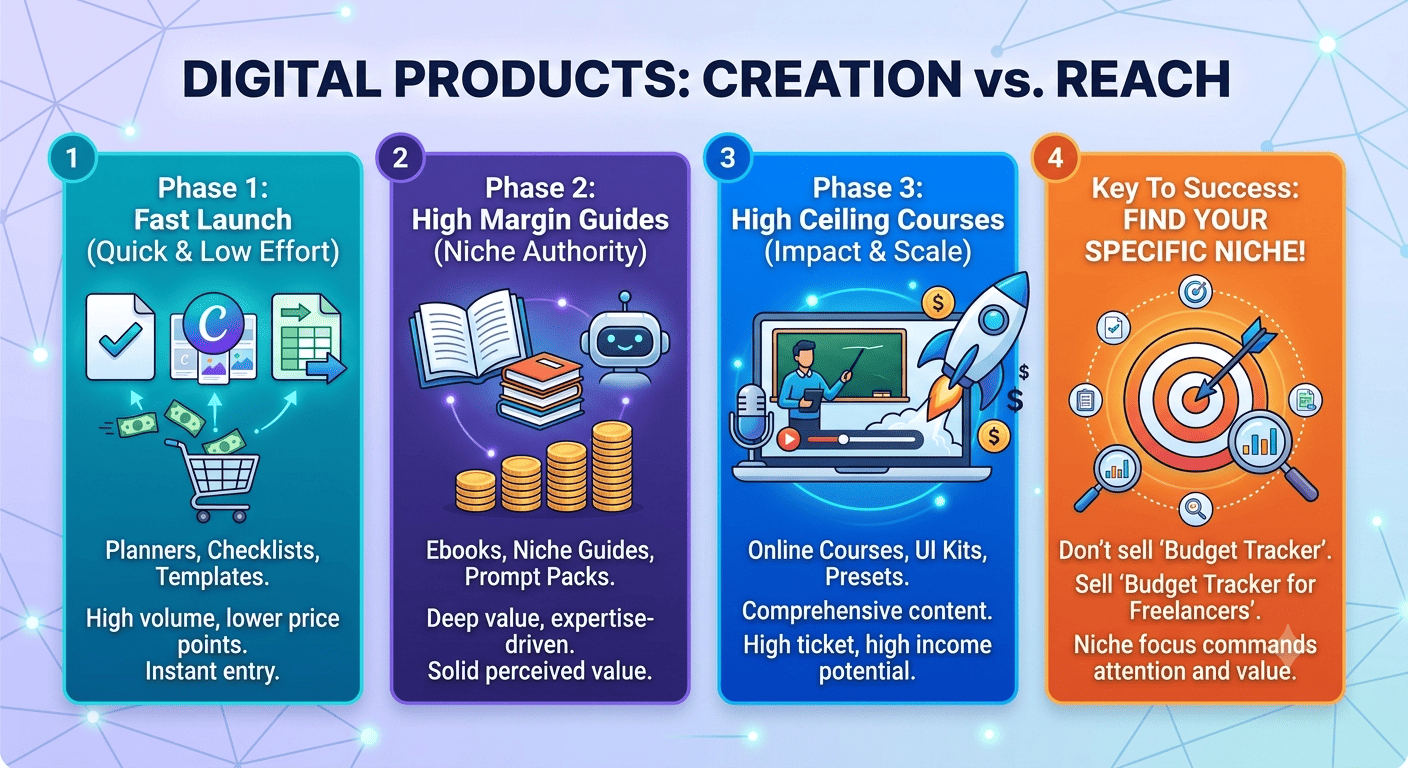
1. Printables (planners, checklists, wall art) — Low effort, quick to design in Canva or Illustrator. Price: $2–$15. Sells well on Etsy in home, wellness, and organization niches.
2. Canva and social media templates — Build one style, duplicate, swap colors and text. Price: $5–$30 for a set. Strong demand from small businesses and creators who want a consistent look without hiring a designer.
3. Notion templates — Currently one of the fastest-moving categories, popular for project management, finances, and content planning. Price: $10–$50.
4. Niche spreadsheets and trackers — Budget trackers, habit trackers, debt payoff planners. Solve one specific problem, which is exactly why they sell. Price: $5–$25.
5. SVG and craft cut files — For the Cricut/Silhouette crowd. Low production time once you’ve built a style. Price: $2–$10 each, often bundled.
6. Ebooks and niche guides — General nonfiction sits around $2.99–$9.99; specific, specialized topics (“budgeting for freelancers” vs. generic money advice) command $4.99–$19.99. Time investment is the main cost — there’s no printing or shipping to eat into margin.
7. AI prompt packs — Curated, tested prompts for a specific use case (content writing, coding, design). Cheap to produce, currently high perceived value given how many people are still figuring out how to use AI tools well.
8. Done-for-you business templates — Contracts, intake forms, onboarding guides, SOPs. Service providers pay well for these because they save hours and make a new business look established fast. Price: $15–$75.
9. Done-for-you email flows — Pre-written welcome sequences, abandoned cart flows, or nurture sequences for a specific niche. Less common than the other categories, which is part of the appeal. Price: $25–$150.
10. Workbooks (CBT-style, journaling, goal-setting) — Structured, printable, often paired with an ebook. Price: $9–$25.
11. Mini-courses and frameworks — Condensed versions of a bigger topic: a checklist, a short video walkthrough, a repeatable process. Buyers want a fast, specific win. Price: $19–$79.
12. Online courses — The highest-ticket common digital product, and the one that takes the most upfront time to build well. Short single-topic courses run $10–$20; comprehensive multi-module courses run $99–$499. Justifies the price if the outcome is genuinely high-value for the buyer.
13. Website themes and UI kits — Requires real design/dev skill, but sells to a market (other creators and small businesses) that’s willing to pay for something that saves them dozens of hours. Price: $30–$150.
14. Lightroom presets and video LUTs — Niche but proven — some creators have built six-figure businesses almost entirely around a signature editing style. Price: $10–$40 per pack.
15. Stock photo and video packs — Higher production effort (you’re the one shooting), but reusable across many buyers once built. Price varies widely by license type.
16. Simple software, plugins, or automation scripts — Highest technical bar on this list, but often the least competitive category because fewer people can build it. Price: highly variable.
17. Guided meditation and breathwork audio — Short 5–20 minute sessions, sold individually or bundled. Low production cost, strong repeat-purchase rate. Price: $4.99–$19.99.
18. Audiobook versions of existing ebooks — If you already have written content, this reaches an audience that reads less and listens more. Price: $9.99–$19.99.
19. Children’s audio stories — A genuinely underserved niche — parents actively search for screen-free entertainment. Price: $2.99–$9.99.
20. AI-personalized products — Personalized children’s books, custom workout plans, tailored templates generated per buyer. Newer category, growing fast, though it leans on tools and workflows that are themselves still evolving.
Looking at that list, the honest filter isn’t “which one is most profitable” — it’s three narrower questions:
If you can’t answer the third question yet, that’s the actual first step — more important than picking a format off this list.
Worth it, yes — automatically passive, no. The “low overhead” part is genuinely true: no inventory, no shipping, no per-unit cost eating your margin. What doesn’t show up in that pitch is that low overhead doesn’t mean low effort — it just moves the effort earlier, into the creation and marketing, instead of into ongoing fulfillment.
The other honest caveat: the obvious niches (generic budget planners, generic productivity templates) are genuinely saturated. The products that still do well tend to be specific rather than broad — which is a theme you’ll notice repeats throughout this whole list.
| Marketplace (Etsy, Creative Market) | Dedicated platform (Gumroad, Sellfy, Payhip) | Your own site (Shopify, WooCommerce) | |
|---|---|---|---|
| Built-in traffic | Highest — buyers are already browsing | Low — you bring your own audience | Lowest — entirely your own traffic |
| Fees | Listing + transaction fees | Monthly or per-sale fees | Platform/hosting cost, generally lower per-sale |
| Control over branding | Limited | Moderate | Full |
| Best for | New sellers with no existing audience | Creators with some following who want more control | Established sellers who already drive their own traffic |
Most sellers starting from zero audience do best on a marketplace first, then migrate to their own platform once they have proof a product sells and don’t want to keep paying marketplace fees on repeat buyers.
Picking a saturated niche with no differentiation. “Another budget tracker” competes with thousands. “A budget tracker for wedding planners” doesn’t.
Weak previews and mockups. Buyers can’t hold a digital product before purchasing — the preview images are doing all the trust-building work a physical product gets for free.
Pricing based on hope, not research. Check what comparable, specific products in your niche are actually charging before picking a number.
Launching with zero validation. Posting in a relevant community, running a small pre-sale, or just asking your existing audience what they’d pay for costs nothing and prevents building something nobody wants.
Here’s where most guides on this topic get misleading — they lead with one creator’s standout number ($50,000, sometimes six figures) presented as typical. It isn’t. Outcomes vary enormously based on three factors: how specific the niche is, how large an audience you already have (or can reach), and price point.
A realistic range for someone starting from scratch, building one solid product, and doing their own marketing: modest supplemental income in the first several months, with growth from there tied directly to how much ongoing marketing and product expansion happens — not something that keeps compounding on autopilot.
The products on this list that tend to work are the specific ones, built by someone who already had the underlying knowledge, sold to a buyer they could describe in one sentence. Everything else on the list- the platform you choose, the price you set- matters less than getting that part right first.