Physical Address
304 North Cardinal St.
Dorchester Center, MA 02124
Physical Address
304 North Cardinal St.
Dorchester Center, MA 02124
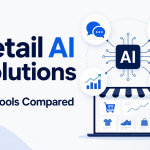
Retail has always been a business of prediction: guessing what customers want before they know it themselves, stocking the right amount of the right product, and pricing it in a way that moves inventory without leaving money on the table. For decades, that prediction was built on experience, spreadsheets, and a fair amount of gut instinct. Artificial intelligence hasn’t replaced that instinct so much as it has industrialized it – turning millions of small behavioral signals into recommendations, prices, and forecasts that update in real time.
The shift has moved quickly. According to Stanford’s AI Index, 78% of organizations reported using AI in 2024, up from 55% the year before, and retail has been one of the more aggressive adopters. This isn’t a future-facing trend piece anymore – AI in retail is now operational infrastructure at companies of nearly every size. Below is a practical breakdown of what AI in retail actually looks like, where it delivers the clearest return, and what smaller retail businesses should realistically expect as they weigh their own adoption.
AI in retail refers to the use of machine learning, natural language processing, and related automation tools to support decisions across the retail business, from what a website recommends to a shopper, to how a warehouse restocks shelves, to how a store prices a jacket on a rainy Tuesday.
It spans both digital and physical retail. Online, AI shows up as recommendation engines, dynamic pricing, and customer-service chatbots. In physical stores, it shows up as demand forecasting, computer-vision-based loss prevention, and layout optimization built from foot-traffic and sales data. The common thread is that AI systems process far more data, far faster, than a person could, and turn that data into a specific, actionable output.
The scale of investment is hard to overstate. Industry surveys have found that 92% of retailers are now investing in AI technology in some form, and 55% are already using it to personalize website experiences and product recommendations. On the customer-service side, AI-driven chatbots can handle up to 80% of routine customer inquiries, freeing human staff for the more complex cases that actually need a person.
The pressure driving this isn’t abstract. During the 2025 holiday season, AI and AI-powered shopping agents played a measurable role in the roughly $1.29 trillion spent globally, including $294 billion in the United States. Adobe separately reported a surge of nearly 2,000% year-over-year in retail site traffic arriving specifically from AI chat interactions during Cyber Monday 2024 – a sign that shoppers themselves are increasingly using AI tools to research and buy, whether or not a retailer has built for it.
AI in retail isn’t a single tool, it’s a set of applications, each solving a different operational problem. Here’s where it’s having the most measurable impact.
This is the most visible use case. Machine learning models analyze browsing history, purchase behavior, and demographic data to serve up product recommendations – the same logic that powers Amazon’s “customers also bought” or Netflix’s suggested titles, applied to a retailer’s own catalog. Done well, personalization increases both conversion rates and average order value, because the shopper is being shown things they’re actually likely to want.
AI-driven pricing engines adjust prices in real time based on demand, competitor pricing, inventory levels, and even local weather or events. This is standard practice in travel and ride-sharing, and retailers – particularly in electronics, apparel, and grocery have adopted the same logic to protect margin during high-demand periods and move inventory faster during slow ones.
Predictive models analyze historical sales, seasonality, and market signals to forecast demand with far more precision than manual planning. This reduces two expensive problems at once: stockouts (lost sales) and overstock (markdowns and dead inventory). AI-based inventory systems can also flag supply chain disruptions early enough for a retailer to adjust orders before a shortage hits the shelf.
Chatbots and virtual assistants now handle a large share of routine retail support – order status, returns, sizing questions, store hours – without a human agent. The better implementations route only the genuinely complex or sensitive issues to a live person, which improves response time for simple questions and preserves staff time for the cases that need judgment.
In physical stores, AI analyzes sensor and camera data to optimize shelf placement, predict which products sell better next to each other, and flag unusual patterns that may indicate theft or fraud. Retailers are also beginning to use AI to help evaluate potential new store locations based on demographic and foot-traffic data, rather than relying purely on historical intuition.
The newest wave, gaining real traction in 2026, is agentic AI tools that don’t just recommend a product but can compare options, apply the best available discount, and complete a purchase with minimal input from the shopper. This is the layer behind the sharp rise in AI-referred retail traffic, and it’s reshaping how retailers think about search, product data, and checkout design, since some of that “browsing” is now being done by a bot on the customer’s behalf.
| AI Application | Primary Impact Area | Typical Retailer Size Using It |
|---|---|---|
| Personalized recommendations | Conversion, average order value | Enterprise & mid-market |
| Dynamic pricing | Margin protection | Enterprise, growing mid-market |
| Demand forecasting | Inventory cost, stockouts | All sizes |
| AI chatbots | Support cost, response time | All sizes |
| Store layout & loss prevention | Shrinkage, sales per square foot | Enterprise & large multi-location |
| Agentic shopping assistants | Discoverability, checkout conversion | Enterprise, emerging mid-market |
If you’re ready to compare specific platforms rather than just the use cases, see our roundup of the best retail AI solutions for 2026 — organized by what each tool actually does best, from customer service to demand forecasting.
The return on AI investment in retail is no longer theoretical. Analysts have estimated that AI in retail has driven roughly $40 billion in additional revenue across a recent three-year span, largely through better demand forecasting and reduced markdown losses. Beyond revenue, the operational case is straightforward: AI reduces the manual hours spent on forecasting, pricing, and basic customer support, and it tends to make those functions more accurate, not just faster.
The compounding advantage matters too. Retailers using AI and machine learning have been shown to outperform those that don’t, and the gap tends to widen over time, early adopters accumulate more data, which makes their models more accurate, which reinforces the advantage.
None of this is frictionless. A few recurring challenges are worth naming plainly:
Much of the reporting on AI in retail focuses on enterprise chains with dedicated data science teams, but the picture for smaller retailers is different and, in some ways, more encouraging than the “AI is only for big companies” narrative suggests. According to Federal Reserve data from April 2026, 78% of the U.S. labor force now works at firms that have adopted some form of AI, and Goldman Sachs’ 10,000 Small Businesses Voices survey found that 76% of small businesses use AI in at least one capacity, with 93% of those users reporting a positive impact on their business. The U.S. Chamber of Commerce separately reported that 58% of small businesses now use generative AI tools, up sharply from just a few years ago.
The gap that remains isn’t access – most of the tools available to large retailers now have smaller-business equivalents, often at a fraction of the cost through cloud-based, subscription pricing. The gap is integration: the Goldman Sachs survey found that while adoption is high, only 14% of small businesses have AI fully embedded in core operations. Most are still using individual tools for individual tasks – a chatbot here, an inventory alert there – rather than a connected system.
For a small or mid-size retailer, the most realistic starting points tend to be the ones with the fastest, most measurable payoff:
A few directions are likely to define the next stage of AI in retail:
AI in retail has moved well past the experimental phase. The applications with the clearest return – personalization, demand forecasting, and customer service automation are now accessible to retailers of nearly any size, not just the enterprise chains that pioneered them. The bigger differentiator going forward won’t be whether a retailer uses AI, but how deliberately it’s integrated: retailers that connect these tools into a coherent system, rather than bolting on one at a time, are the ones most likely to see the compounding advantage the data already shows.