Physical Address
304 North Cardinal St.
Dorchester Center, MA 02124
Physical Address
304 North Cardinal St.
Dorchester Center, MA 02124
Three winters ago, I decided delivery driving was going to be my genius side hustle. I had a car, a phone, and crucially a wildly inflated sense of how much “flexible income” actually means. I pictured myself cruising around town, podcast on, cash rolling in between errands. Two hours and four food deliveries later, I’d made $19. Minus gas, that came out to something like $6.40 an hour, which is less than I would’ve made standing perfectly still and doing nothing. I still, for reasons I cannot defend, kept the app on my phone for another eight months.
So: are delivery apps actually a smart way to make money, or just a well-marketed way to burn a tank of gas for gas-station wages? The honest answer is it depends entirely on which app, which city, which hours, and whether you’re willing to treat it like a numbers game instead of a vibe. Here’s what the data and a lot of driver forums actually say.
Below is the real breakdown of what each one pays, who it’s actually good for, and where the marketing outruns reality.
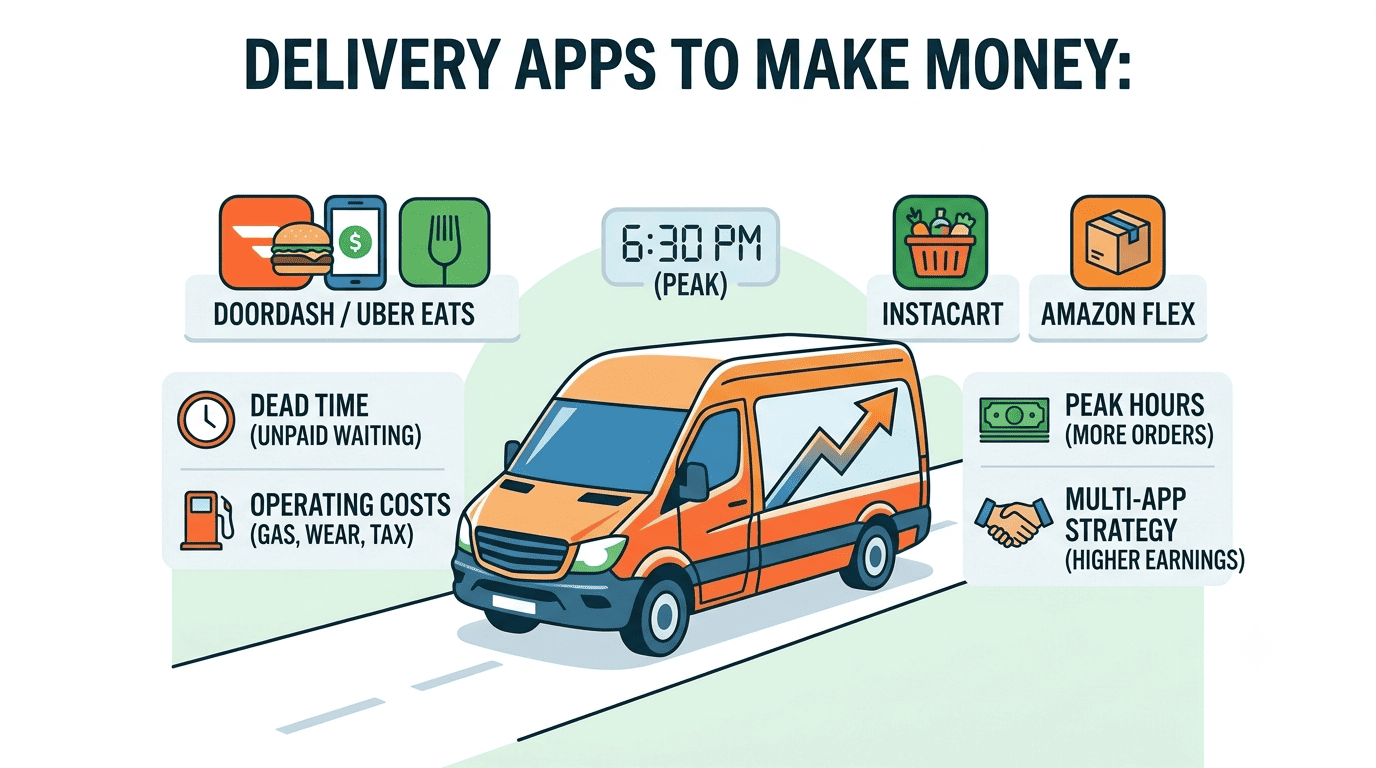
DoorDash remains the biggest name in the game, and for good reason- the order volume is unmatched in most cities, and sign-up takes about five minutes. Average pay lands around $15–$25 an hour before expenses, though that range swings hard depending on your market and whether you’re driving during a genuine rush or just refreshing the app hoping something pings. The tradeoff for that volume is competition: in saturated areas, you’ll spend real time waiting between orders, and that dead time doesn’t pay.
Worth it if you live somewhere with consistent lunch and dinner demand. Less worth it if you’re in a smaller market where three other Dashers are circling the same three restaurants.
If you’re already signed up to drive passengers, Uber Eats is close to a no-brainer — you can toggle to delivery when rides slow down and keep earning either way. On its own, though, the pay is a touch lower than DoorDash in most markets, generally $12–$20 an hour. The real value here is flexibility: fewer awkward conversations with strangers in your back seat, more control over exactly what kind of driving you’re doing at any given moment.
Instacart flips the model: instead of picking up and dropping off, you’re shopping an actual grocery list, which means more time per order but noticeably higher pay — often $15–$30 an hour, with the top end reserved for big batches during peak hours. It’s more physically and mentally involved than food delivery (substitutions, weighing produce, hunting down that one specific brand of oat milk), but the tipping culture tends to reward shoppers who communicate well and get orders right the first time.
This is a strong option if you’d rather be inside a store than behind a wheel for three straight hours.
Shipt runs on a similar model to Instacart — shop, deliver, repeat — but it’s built around Target and a handful of retail partners, and shoppers who build repeat relationships with the same customers often see it pay off in loyalty and better tips. Average pay sits around $16–$22 an hour. The catch: getting approved can take longer than some competitors, and route availability depends heavily on how saturated your zip code already is with other shoppers.
Of the mainstream apps, Amazon Flex is frequently cited as one of the better-paying choices — $18–$25 an hour is a common range, and you know your earnings upfront because you’re booking a fixed block (usually two to four hours) rather than gambling on per-order pings. The predictability is the whole appeal. The downside is that popular blocks get snapped up fast, so if you’re not fast on the draw when new slots post, you may find yourself checking the app repeatedly with nothing to show for it.
Spark doesn’t get talked about as much as the bigger names, but it’s worth a look if there’s a Walmart or Sam’s Club nearby — you’ll deliver groceries and general merchandise, and pay tends to land in a similar range to Instacart and Shipt. Availability is the limiting factor here more than pay; it’s simply not as widespread yet.
Grubhub was one of the original food delivery apps, and while it’s lost significant market share to DoorDash and Uber Eats and changed corporate ownership more than once along the way, it still operates its own driver network in a number of cities. Pay tends to run $10–$17 an hour, generally lower than DoorDash or Uber Eats, but drivers in dense urban markets sometimes report steadier demand and fewer wild swings in order flow.
Roadie takes a genuinely different approach: instead of building a schedule around deliveries, it’s designed to monetize trips you’re already taking. Multi-stop gigs pay somewhere in the $25–$50 range, and there’s no requirement that you’re delivering food- it might be a suitcase, a piece of furniture, or a random Craigslist find someone needs moved across town. It’s less a full-time income stream and more a way to make an errand you were running anyway slightly less annoying.
This is the piece most “best delivery apps” lists gloss over: apps built around heavy or bulky items — think Bungii, GoShare, and Curri — consistently pay more per hour than food delivery, sometimes two to three times as much. One 2026 industry analysis tracking roughly a billion gig trips found task-based hauling work outearning standard food delivery by a wide margin. The logic checks out: fewer people own a pickup truck or cargo van, so the pool of available drivers is smaller, and platforms pay a premium to fill jobs. The tradeoff is obvious, you need the right vehicle, and you need to be willing to actually lift the couch.
Here’s where the marketing and the math tend to part ways. Every app’s advertised hourly rate is gross pay- before gas, before the extra wear on your brakes and transmission, before the portion of your car’s depreciation that’s quietly happening every time you drive for money instead of pleasure. A driver technically “earning” $22 an hour on paper might be walking away with closer to $15–$17 once fuel and mileage are accounted for, and that’s before you’ve set aside anything for the self-employment tax bill waiting for you the following spring.
Almost every experienced driver will tell you the same thing: don’t marry one app. Running DoorDash, Uber Eats, and Instacart simultaneously and accepting whichever offer pings highest first- is the closest thing to a proven strategy in this space. It fills the dead time that kills your hourly rate on any single platform, and it hedges against the days when one app’s demand mysteriously dries up for no explainable reason (every driver has a story about this).
The tradeoff is mental load. Juggling three notification streams while driving isn’t for everyone, and there’s a real argument for picking one or two apps you can actually manage well rather than spreading yourself across five and doing all of them mediocre.
A few things worth knowing before you sign up for anything:
None of this means delivery apps are a bad way to make money for a lot of people, especially those with an already-flexible schedule, they’re a genuinely useful way to turn spare hours into cash without a job interview. But treating it as a strategic, numbers-driven side hustle instead of easy money is what separates the drivers actually building meaningful extra income from the ones burning gas for less than minimum wage- which, if it wasn’t already obvious, is a club I know from firsthand, deeply humbling experience.